
The Voice of the Octagon: Stars will fall
Practice session improvisation. We are The Voice of the Octagon and we live-mix jazz from the future.
The Voice of the Octagon: Two Stops
Newest music project. The Voice of the Octagon — a duo featuring dueling laptops , sax, bass, an analog synth, and jazz from the future! Check it out on thevoiceoftheoctagon.com
Miles Ahead: Summertime
10 Mar 2013 Cafe International
Deer Inbetween, The Musical!
The mushrooms from Upper Management hired me to write a song.
Miles Ahead – Footprints
Cafe International, Feb 10, 2013
You should be learning music theory on guitar
Western music theory involves many aspects of sound, but the one we musicians spend the most time learning and internalizing is pitch. In Western music since the rise of equal temperament, this means the relationship between pitches — chords and scales and how they create tension and resolution. For most people studying music, we learn these concepts on the piano.
But is the piano the best instrument for internalizing the concept of harmony as the set of relationships between notes? I here to argue that the guitar provides a better foundation for understanding.
The guitar exposes the theory, the piano hides it
The nuts and bolts of a piano and a guitar are similar. To make notes, each vibrates strings that vary in length. The lengths of the strings (as well as materials, thickness, tension) . A guitar player gains a fundamental understanding of this just by playing the instrument because a guitarist directly changes the length of the strings to change the notes. A guitarist quickly learns the physical relationships between the notes, and internalizes equal-temperament — natural fourths are always five frets apart, octaves are always 12 frets apart, and so on. This applies to chords as well. Here are three major chords on the piano:
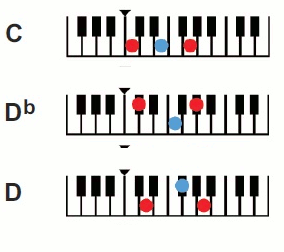
And here they are on the guitar:
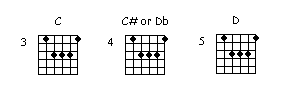
The guitar reinforces the notion that all major chords are fundamentally the same — the chords are made of ratios based on a root note. A guitarist literally gets a “feel” for a major chord, unrelated to any particular key. For the piano player, these ideas are abstracted away inside the piano. The strings are hidden from view, and there’s no consistent physical pattern to playing the same type of chord. The piano player has to develop the spatial and muscle memory for these three basic major chords independently of each other.
The piano is biased toward the key of C
The piano player is ultimately at a disadvantage because they keyboard was designed before the evolution of modulation in Western music, and is biased toward staying in one key. The white keys are the notes in the C major scale, and the black keys are the “accidental” notes excluded from the key. This makes playing/improvising in C very easy — just avoid the black keys! However, much music since the Baroque Era creates interest by changing keys gracefully, and a lot of music is no longer written in the key of C. On the piano some keys are easier than others: most piano players have an easier time in C (no black keys) than in E (4 black keys ). For even an intermediate guitar player, playing in these two keys is the same because all major keys are the same.
Next time: the C major (and piano) bias in our sheet music system of notation…
Central Park West
Rob Figliuzzi on guitar, with Rachael Zisette ( d ), Mike Parsons ( p ), and Ted M Superstar ( b, pictured ) at Sheba Lounge on Fillmore in San Francisco, Jan 19, 2013
Miles Ahead – Canteloupe Island
Jan 6, 2013
5150 – My Little Suede Shoes
New Years Eve 2012-2013 at Monarch in San Francisco. And yes, there were aerialists performing while we were playing.
 ted m superstar - jazz bassist in san francisco